Energy Storage On The Go

Last time we talked about the importance of batteries to our transformation of the energy grid to a progressively more renewable one. I think it makes sense to for us to talk about another green topic that is not necessarily renewable energy generating, but especially important in reducing our carbon footprint and heavily reliant on innovations in batteries. I am referring to the electric vehicle (EV) market, and more broadly, the entire infrastructure surrounding the industry. I have heard the argument countless times: that EV are not cleaner than traditional combustion engines because the energy they require still needs to be produced somewhere, and more often than not this will be at a fossil fuel burning plant, (remember, only 11% of the US energy grid is powered by renewables). Let’s nip this argument right in the bud. A consumer report study looked into this and found out that across the US, EV are at a minimum 20% cleaner than their combustion engine counter parts and on average 60% cleaner across the entire country. The best part is that as we move to a heavier reliance on renewable energy sources to power our grid, EV will only get cleaner.
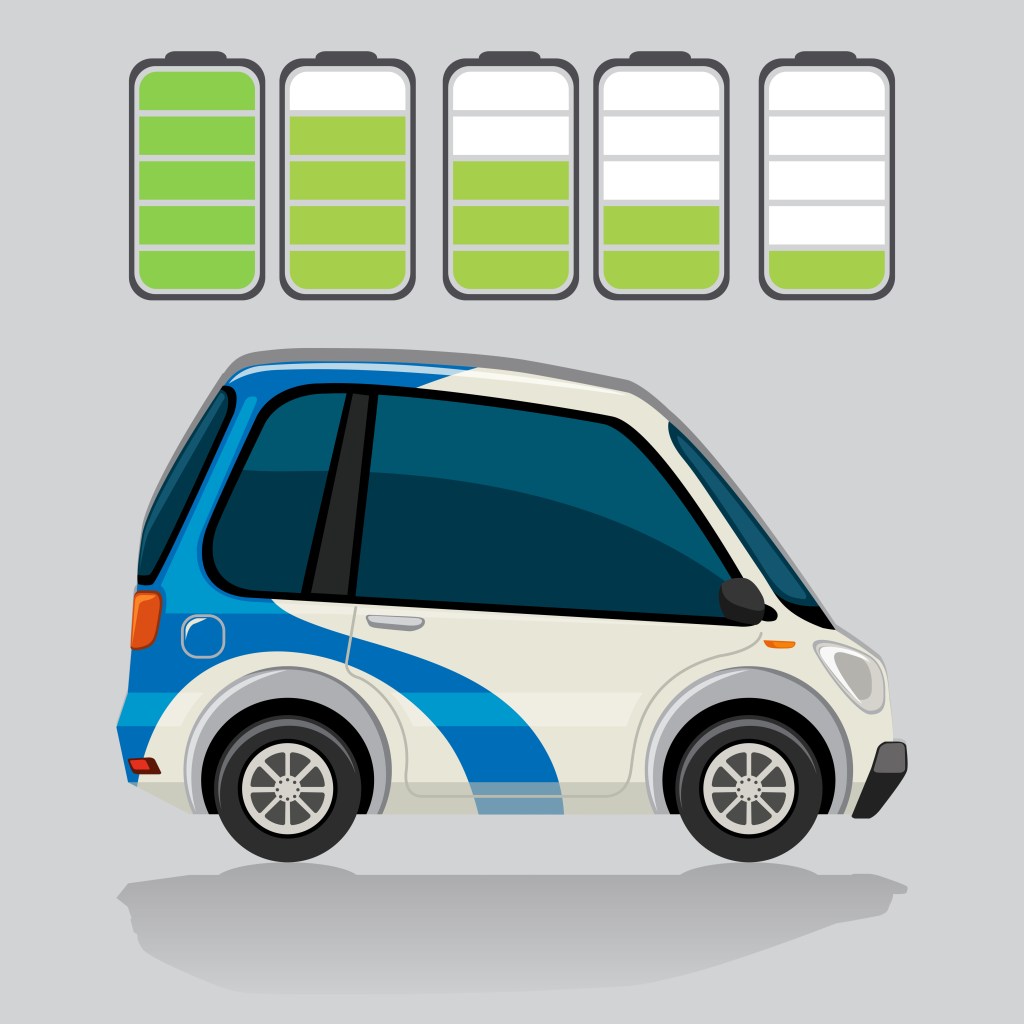
Photo Credit: Brgfx on Freepik

Back to batteries for a moment. Batteries are essential to the EV market as vehicles become more appealing with longer range possibilities on a single charge. Let’s take a look at the Model S by Tesla. This model was announced back in 2012 and debuted with a range of 136 to 265 miles on a single charge, depending on driving conditions. For comparison, the 2021 Model S boasts a range of 387 to 520 miles on a fully charged battery, and all this on an 85-kwh battery. I’m not going to do the math on how many smoothies a battery like that is worth. The progress of this extremely exciting and I am willing to bet will only increase in rate of progress moving forward.

Tesla has been the leader in the EV marketplace for some time. A position it has earned by more or less creating the marketplace in the first place. However, there is blood in the water now and the industry giants are ready to frenzy. Tesla has proved that there is a demand for EVs, and one that they often cannot meet. This surge in demand has led to an influx of both established auto makers jumping into the fold as well as new start ups trying find their market share. Take Ford for example. They have reinvented arguably the most iconic symbol of the American open road into an EV with the Mustang Mach-E which is equipped with a 68 kwh battery and range of 305 miles. Though this isn’t quite beating the Model S yet, it is competing with the Model 3 who’s range is reported between 263 and 353 miles at a comparable price point. There also exciting new EVs that have been rumored to push the range thresholds; the Nikola Badger claimed it would have a range of 600 miles.

If you’re excited about any of the rumored EVs coming out soon, leave a comment down below. 
300,526 Smoothies

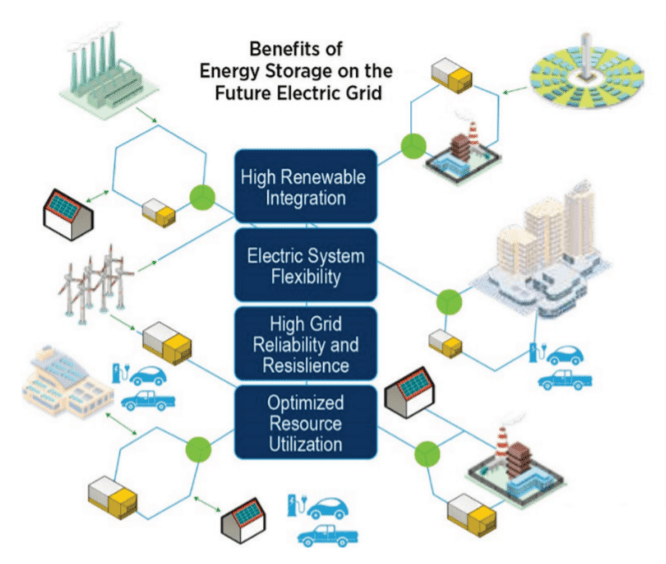
The one argument I can pose against renewables as the backbone of our energy grid is that they aren’t… well consistently reliable. You can have as many solar panels as you want. They can cover your roof and yard. Yet, without sunlight they won’t do you any good. Wind turbines are great until there is no wind. We cannot control the weather and at times the sun will shine and we can harness excess energy to the full capacity of our solar panels, but the sun shining today has little influence on if I need to charge my laptop tomorrow, or if I’m going to want to watch TV next winter. We need to bridge the gap between when we capture the abundant renewable energy around us and when we want to use it. The obvious answer here is batteries. So, let’s look at the how we store renewable energy today.

The largest store of renewable energy in the US is currently dams. Unlike a wind turbine of solar panel that needs the appropriate weather conditions to generate energy, a dam can store its energy producing resource, water, and then release the water to rotate its turbines as the need for energy arises. As of 2020 the US has 22 gigawatts of energy stored in dams. Unfortunately, this is the majority of our renewable energy storage capacity, with only an additional gigawatt of storage capacity in batteries. On a global scale, the International Renewable Energy Agency’s (IRENA’s) study on renewable energy storage is optimistic and the forecast is driven by declining costs. Per the IRENA, by 2030 total costs for installed battery systems could fall anywhere between 50-60% with prices reaching as low as $200 per kilowatt hour of energy storage. Though this is promising and exciting, this cost may still be a barrier to entry for many as the average price of a kilowatt hour in the US is only 13.31 cents. For a frame of reference, a kilowatt hour is sufficient energy to make 200 smoothies. So, in order to pay off each kilowatt hour battery, you would need to make 300,526 smoothies…

Photo Credit: US Department of Energy

We may be a ways-off of large-scale adoption of battery systems at home, but what about utility scale adoption? Well as of today, we don’t quite have a solution for utility scale adoption but that doesn’t mean that we aren’t striving towards it. Here is a report by the U.S. Department of Energy highlighting over 30 research teams that are working on innovative ways to tackle our energy storage woes. These research topics range from improving existing technologies such as the architecture of lithium-ion batteries and improving zinc-bromide flow batteries to experimenting with new energy dense element composites for batteries. The takeaway here is that even though we do not have an answer right now, we do have thirty+ potential answers, or even partial answers that can be utilized in the future to meet our energy storing needs.

If there are any battery innovations you are most excited about, leave a comment down below to keep the conversation going.

The Dark Side of Solar

Earlier this week we discussed the drawbacks of hydroelectricity. In my last post I touched on potential drawbacks of solar farms. Before I continue, I will emphasize that I am a staunch believer that renewable energy is the future of our energy grid and the key to a habitable planet sustaining a wide biodiversity. However, as I have stated in previous posts, I believe that having a discussion, to address both sides of the issue is vital to solving our problems and finding the most suitable course of action. Solar or photovoltaic energy is a phenomenal innovation and I hope it will be at the forefront of domestic energy production. Solar energy is also the cheapest electricity in the history of, well, electricity. However, there are some drawbacks that need to be considered.

Southwestern willow flycatcher, photo credit: U.S. Geological Survey

Above I mentioned domestic production of energy via photovoltaic panels, which circumvents the first draw back of utility scale solar energy farms, wildlife habitat loss. In 2020 the United States power grid generated roughly 0.004 billion gigawatts of energy. Secondly, it takes 2.8 acres to produce one gigawatt of energy per year. That would mean that we would need to cover 11.2 million acres of land in solar panels if we were to build an entirely solar energy grid. That is somewhere directly in the middle of the land mass of Maryland and West Virginia. Thinking about utility scale solar farms, it would be intuitive to place these projects in the south western U.S. deserts as the sunshine is strong and consistent with minimal rainfall. However, further destruction of these habitats puts further strain on the populations of the desert tortoise, the devils hole pupfish, the southwestern willow flycatcher, and Amargosa toad, to name a few.

So, would a domestic grid alleviate the land use debacle? Yes, but there are other ways that photovoltaic panels can still contribute to an unsustainable environment. When it comes to tech, the environmental impact is often not secluded to the product itself but also lies in the production process as well as the harvesting of the raw materials necessary to begin the production process. For example, silicon is an integral part of a photovoltaic panel. Silicon needs to be mined as quartz and then processed or as silica sand. Not to get too in depth on this matter, but it is an important factor to consider as the mining of this resource contributes to polluting local wells and ground water as well as polluting the air around the mine. And this is only including one element that makes its way into the finished product and not even beginning to consider the chemicals needed to appropriately process the raw or refined materials into the finished product.

My point here is that we need to consider the costs, other than monetary when designing a renewable grid for the future. There are factors we can alleviate, such as habitat destruction by opting for domestic solar production, and factors that appear to be a sunk cost on the road to progress. I am not saying that it needs to be that way, nor am I saying I have all the answers. I am simply trying to start a conversation in the hope of spreading awareness that can lead to actionable changes. If you would like to continue this conversation, leave a comment down below, or start a conversation of your own.  

Green Nevada

I have briefly sung the praises of my home state of Nevada for being the second largest geothermal energy producing powerhouse in the United States. However, there is a good deal more renewable energy in Nevada than just its geothermal capacity. It should be noted that Nevada is the 32nd most populous state in the country, and over 80% of the state’s land is currently managed by the federal government. I see this as an opportunity to utilize sparsely populated areas to capture solar and wind energy across the state, thus bolstering both the state’s economy and its energy independence. In 2019, 85% of the energy consumed in Nevada was generated in a different state.

Primarily driven by solar, geothermal, and hydroelectric 28% of the energy produced in Nevada is renewable. If energy production in the state were to increase, this production composition would be far superior to the national figure of 11% renewable energy production. Another surprising figure about Nevada’s grid is that its third largest power plant by capacity is actually a renewable energy plant. This power plant is the Hoover Dam, with a capacity to produce 2,080 megawatts of energy. The largest geothermal power plant in Nevada is Steamboat Hills, who’s capacity pales in comparison to Hoover Dam at 84 megawatts. I will note however, that every megawatt of renewable energy is a contribution to a carbon free future.

Nevada is also the home for innovations in the sphere of renewables. In May of 2020, the Trump administration approved the construction of what will be the largest solar farm in the United States to be located just 30 miles outside of Las Vegas. This farm will have a capacity of 440 megawatts in its first, 11 square mile phase, and an additional 250 megawatts of capacity will be added during phase two. The projected generational capacity will be able to generate sufficient electricity to power 260,000 households. The energy generated here will also offset about 382 metric tons of carbon from being released into our atmosphere. However, like with the environmental draw backs of dams, this solar project also has consequences on the environment. Critics of this project indicate that this will severely and adversely affect the habitat of the desert tortoise, which is native to the area and already vulnerable.

Desert Tortoise, Photo credit: United States Geological Survey

Innovation in Nevada is not limited to its southern deserts. While southern Nevada can boast the largest solar farm in the U.S. (in the near future), northern Nevada already has something truly unique and groundbreaking. Located outside of Fallon is the world’s only triple hybrid renewable power plant. Enel Green Stillwater Plant combines geothermal energy with solar panels which produce solar energy the way described in my post here. The third part of this one-of-a-kind puzzle is the addition of solar thermal power. Solar thermal power is similar to binary cycle geothermal plant, using a working fluid heated by the thermal energy from the sun to create steam from water and rotate a turbine.

If there are any renewable developments in Nevada that you are excited about, leave a comment below!

Dam It All

In my last post I discussed the renewable energy grid in the United States. Renewables make up 11%. I discussed wind, solar, and geothermal and substantive contributors to that 11% figure, but I noticeably did not delve into hydro electric which makes up 22% of renewable energy in the U.S. I believe that much like nuclear; hydroelectricity has its controversies and deserves a deeper conversation to truly weigh all the nuances. Hydroelectricity in the context of this post will cover dams and their use in the U.S. I am not referring to tidal current turbines when I refer to hydroelectricity.

Let us start with the usual and have a quick ELI5 of hydroelectricity. We have covered turbines so many times in this blog that it seems redundant to do so again, but here we are. Much like wind, geothermal, and even fossil fuel plants, hydroelectricity is harnessed by the turning of turbines. Though, in this case the water is simply allowed to flow through a penstock and turn the turbines. Heating the water inro steam to rotate turbines is not necessary. As far as the prevalence of hydroelectricity is concerned, just about 50% of its capacity is in California, Washington, and Oregon, and the top producing state in the country is Washington as hydroelectricity relies heavily on consistent precipitation. 

Photo Credit: Tennessee Valley Authority

Now if you are reading my blog, chances are that you have seen the movie DamNation which chronicles the problems with hydroelectricity. If not, the movie stresses cultural impacts that dams have had on native peoples in the U.S. Additionally, dams cause harm to the ecosystem by disrupting the breeding patterns of wildlife, such as salmon which instinctively try to swim up streams that have been dammed off. Dams also have an impact on the water quality by both creating pools of “hot” stagnant water and by releasing oxygen deprived water into the local rivers which puts additional stress on wildlife.  

Photo Credit: The Energy Information Agency

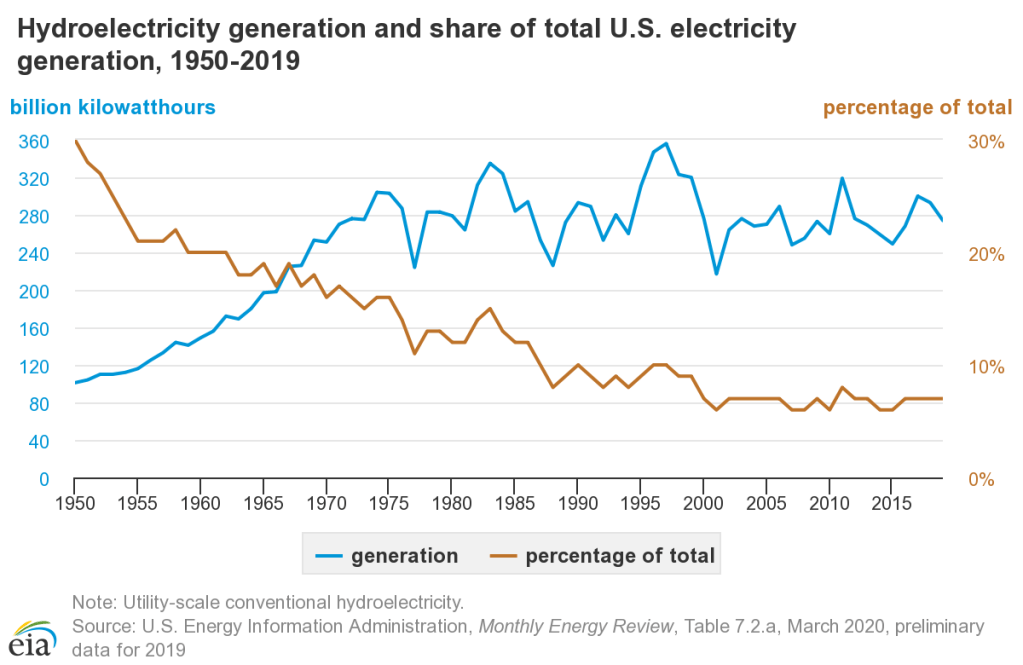
At this point, hydroelectricity makes up about 6.6% of the U.S. energy grid, a percentage that has been decreasing since the 1950s, but has stagnated since the early 2000s. Though I believe that with the rise of other renewables and the decrease in the price per kilowatt hour produced by those methods, I am hopeful that we can commit to the final push away from hydroelectricity. Unfortunately, hydroelectricity is not the only driving factor when it comes to dams. In fact, it is not the main factor at all as only 3% of dams in the U.S. are electricity producing. The majority of dams in the U.S. were constructed for irrigation and water management purposes. As we move away from hydroelectricity in this country, it is also important that we find new ways of managing our water to sustain our agribusiness to be able to cohabitate with the environment and native species around us.

If you would like to discuss dams further or have a differing opinion, please leave a comment below.

True Grid

Given everything that we have talked about over the last few weeks I think it is about time we talk about the current state of the United States’ green grid. Before we begin to look at the consumption of energy in the US, we have a new term to learn: British Thermal Units, or Btu. Btu measures heat energy which allows us to compare gallons of gasoline to tons of coal to kilowatts of electricity. 100 Btu is about 29.3 watts. Per the US Energy Information Administration, the US consumed a total of 100.2 quadrillion Btu or 29.37 quadrillion watts of energy in 2019. For scale, a laptop takes anywhere between 50 to 100 watts to operate for an hour. I will let you do the math on that one.

In the United States 11% of the energy consumed is renewable energy and 8% is nuclear. Of the 11% that is renewable 44% is derived from some biomass source, such as methane. Now this isn’t necessarily green even though it is more sustainable than coal. The remaining 56% came from truly green renewables such as solar, wind, and geothermal. Unfortunately, 56% of 11% is only 6.2% of our energy consumption. But this blog is about being hopeful of the future of renewables so let us consider the positive trends. In 2000 alone our energy consumption derived from coal vs renewables was at a ratio of 3.7:1. Today this ratio is at 1:1, well slightly better than 1:1 as renewables accounted to 0.15 quadrillion more Btu than coal in 2019. Renewable energy consumption is on an upward trend, and in 2019 reached record highs.

Photo credit: The Energy Information Adminsitraion

Now let us get acquainted with who the largest producers of renewable energy are in the United States. Under the guidance of none other than Rick Perry, the 14th US Secretary of Energy and 47th governor of Texas, the state of Texas transformed its energy grid, for better or for worse. This transformation made Texas the number one wind producing state in the country with the capacity to generate just shy of 25 thousand megawatts of power. According to Perry himself, Texas alone harvests more wind energy than all but five other countries in the world. Perry was unavailable for a comment as to what these five countries are.

When it comes to solar, we still see Texas near the top of the list, though it falls to second with 7.8 thousand megawatts of capacity. The top solar energy producing state is California which dominates this category of renewables with a 31.3-thousand-megawatt capacity. California also reigns as king when it comes to geothermal energy, of which it produces 71.2% of the 16 million megawatts produced in 2019. I would be remiss to not mention that my current home state of Nevada takes the silver producing 23.5% of the US’s geothermal energy. But where Nevada takes the gold is that it has the highest geothermal share of all electricity produced within a state at 9.5%.

As always if you would like to continue this discussion please feel free to leave a comment down below or connect with me via my various social media platforms linked on the right.

Gassy for the Greater Good

Ending our excursion into nuclear over the last few posts, we are going back to the ELI5 explanations of how various kinds of renewable energy work. Today we are going to talk about biofuels and more specifically landfill gas, LFG. Outside of the pollution caused by our energy consumption, the population of the United States produces 292 million tons of trash, annually. Out of these 292 million tons, at least 39.89% is comprised of some sort of biomass. Biomass meaning food, yard trimmings, wood, etc.… All of this biomass produces methane while it decomposes. The issue with methane vs simply carbon dioxide is that it is a more harmful to the planet. Over the course of 100 years, methane has the potential to have an impact 25 times larger on global warming than carbon dioxide.

Now the amazing thing about methane is that it is combustible and thus can be used as energy! But you may be asking yourself, why burn methane back into the atmosphere if it is so bad for the environment? When burned, methane gas produces carbon dioxide and water as waste material. Now this isn’t to say that we want to be producing carbon dioxide to power our grid, but it is a clear winner when compared to releasing methane directly into the atmosphere as methane is the more potent greenhouse gas. Methane combustion may not be the final solution to carbon emissions and global warming; however, it definitely buys us some more time by slowing the rate at which greenhouse gasses are emitted into the atmosphere.

Photo credit: Environmental Protection Agency

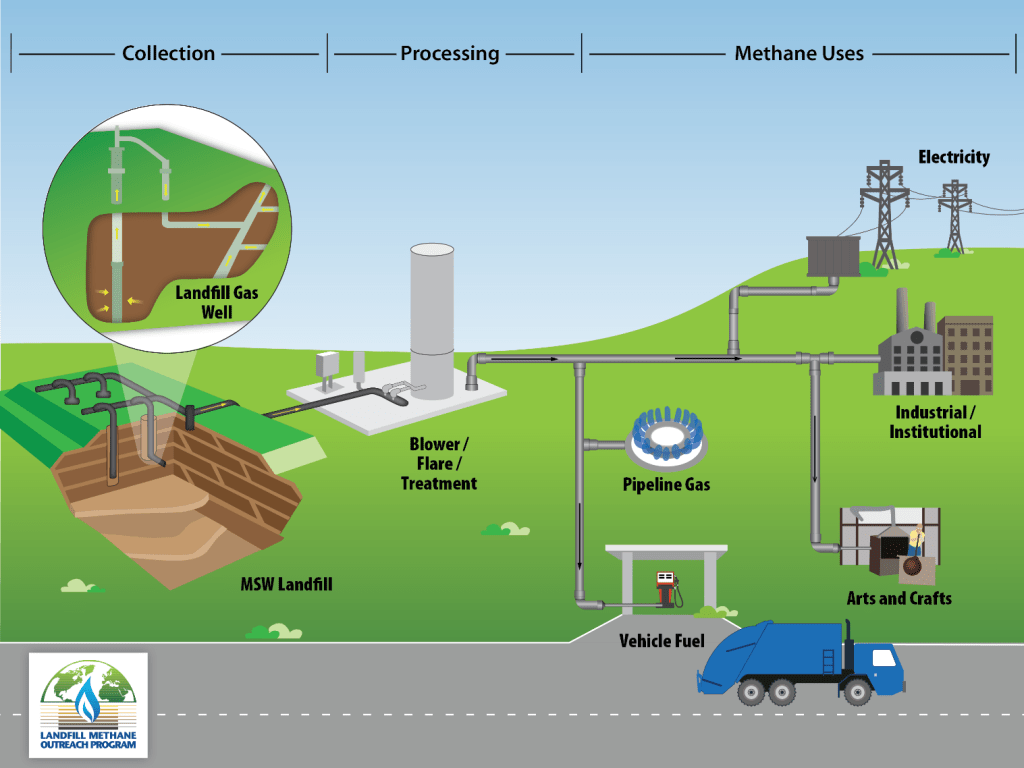
So now that we can agree that collecting and combusting methane is the lesser of two evils, how do we collect it? Well, once we have a landfill, we need to treat it similarly to a well. The landfill needs to be covered to ensure that methane emissions do not escape into the atmosphere. These emissions are harvested through a gas well that then pumps the raw emissions into primary processing and flare. The primary processing step is to remove any moisture from the gas collected. Depending on the destination of the gas there can also be secondary and tertiary processing that will further remove compounds from the gas to ensure it meets certain standards. For example, in the second phase of processing siloxane and sulfur will be removed from the gas and then the product can be used to run a boiler. Underdoing further processing would remove other gases in the gas mixture depending on the intended use of the gas. With the appropriate treatment this gas can be used to power vehicles, produce electricity, or other industrial uses.

Though methane and land fill gas may not be an ideal solution to our electrical and fuel needs, I believe that it is without a doubt a necessary tool to utilize along the way to a net zero carbon future. If you agree or disagree leave a comment below to continue the discussion.

A Nuclear Free Future

Continuing and concluding our nuclear discussion today, I would like to point out that over my last two posts, here and here, I have discussed the pros and cons of nuclear and the drawbacks and costs of investing into new nuclear capacity. A perfect conclusion to this three-piece excursion into nuclear is discussing how we can start to divest from nuclear and move away from the plants that are currently operational. On March 11th, Germany announced that it plans to shut down the rest of its nuclear powerplants by the end of 2022.

In 2011 Germany had just 17 nuclear facilities, generating one quarter of the electricity used in the country. By December 2019, the figures shifted to seven operating facilities, generating 12% of Germany’s electricity. This shows that prior to this declaration Germany was already pursuing the closure of its nuclear power plants and this announcement is a revitalized commitment for the final push. Another important factor to consider is the general unpopularity of nuclear facilities in Germany, which elected a government that could commit to phasing out unpopular energy sources.

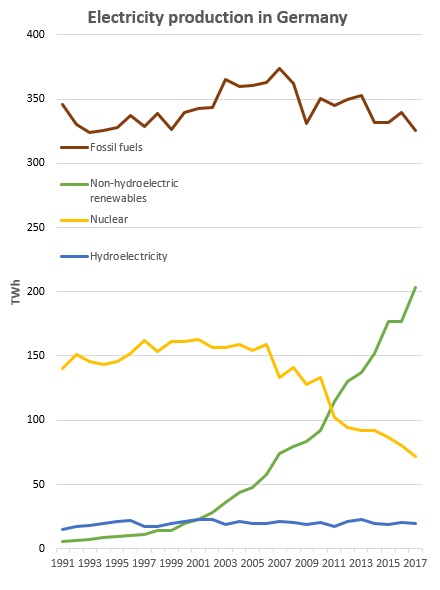
If we were to average the decline in energy production from nuclear between 2011 (40%) and 2022 (0%) we could see that on a yearly basis Germany has needed to replace about 3.6% of its energy production in any given year to keep up with this phasing out. Looking at the movements in the graph below we can see that fossil fuels have remained stable while all the divesting from nuclear has led to a near direct investment in renewable energy sources.

Graph created by the EIA. The full portfolio can be found here.

 Now the issue facing Germany is the proximity of its neighbors’ nuclear facilities, namely France which generates 70.6% of its energy from nuclear power. German environment minister Svenja Schulze reaffirmed, on the topic France’s reliance on nuclear energy, that the principle of energy sovereignty must stand. However, the phasing out of nuclear energy in Germany is just the first step in the nuclear phase out objectives published by the Environmental Ministry. The key objectives listed also indicate objectives to decrease nuclear risk in all Europe. Now I am curious about what Germany’s role will look like in such a broad objective. Being an economic powerhouse in Europe, I hope that this means that Germany will lead the way in investing in renewables in its neighboring nations as well as providing guidance on the phase out process in other nations.

If you liked this piece or have a topic you would like me to address, leave a comment down below. As always you can connect me with on my social media, links are located to the right of this post. 

Nuclear: A Further Discussion

In my previous post I discussed nuclear energy. The manner in which nuclear energy is used to generate electricity as well as some pros and cons about its implications. By a fortuitous coincidence, just two days after I posted my thoughts, Mycle Schneider released bold statement regarding nuclear energy: “Every euro invested in nuclear power makes the climate crisis worse.” For those of you that do not know, Mycle Schneider is the editor of the World Nuclear Industry Status Report. You can read the full report here. This post will discuss in detail and provide further insight to the concerns raised by Schneider.

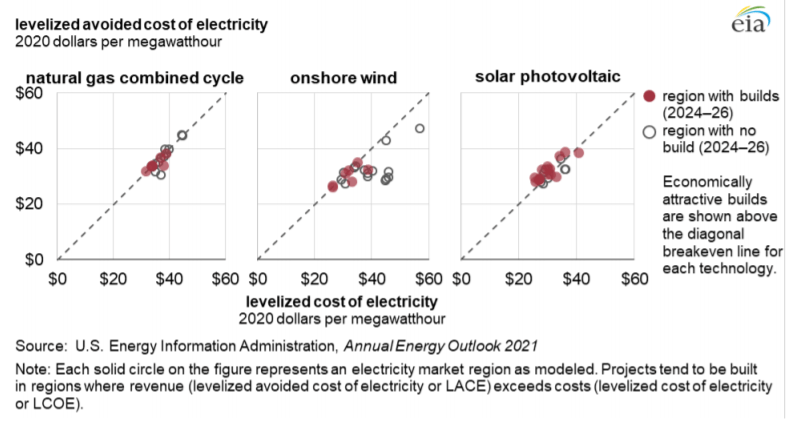
“It (nuclear) is the most expensive form of electricity generation today, but, above all, because it takes a long time to build reactors.” I think that this is an extremely valid point on two fronts. At first, there is the obvious monetary cost to consider. Factoring in both financing, construction, and operating costs over the projected lifetime of a nuclear facility, the World Nuclear association concluded (March 2020) that on average a nuclear power plant will produce electricity at a price of $60 per megawatt hour. For comparison the 2021 Annual Energy Outlook report by the U.S. Energy Information Administration indicated that the levelized cost per megawatt hour of natural gas, on shore wind, and solar ranged between $30 and $40 on average. But we also need to look at the time cost on these projects. A nuclear power plant takes up about five years to construct while, comparatively a wind farm can be completed in eight to ten months. Fighting global warming is a race against the clock and time is a resource that we are running out of far quicker than financials. Choosing our investments for the energy grid, we need to not only weight megawatt output but also our time horizon. A 500% increase in construction time is not an investment we can afford.

EIA Annual Energy Outlook 2021

“…renewables today have become so cheap that in many cases they are below the basic operating costs of nuclear power plants.” This point is also indicative of a bigger problem facing the nuclear energy industry. Soon it will no longer be profitable/able to compete with cheaper sources of electricity. Figures published by the World Nuclear Industry Status Report show that nuclear energy operating costs are now more expensive than even coal per kilowatt hour produced. Being a credit analyst by profession I see two major pitfalls here for the nuclear industry, also addressed by Schneider. The obvious is that nuclear energy will not be profitable with major government subsidies in the not-too-distant future and an industry cannot depend on the good will of the government to keep it afloat, especially in the current political climate where we face increased radicalization and larger swings in policy. The second is a balance sheet issue for energy companies already invested in nuclear. If a plant were to be decommissioned that would erase assets on the company’s balance sheet, but the liabilities would not simply be decommissioned as well. This would mean that the net worth would plumet while leverage would drastically increase. The implications of this on Wall Street could amount to the equivalent of the 2008 housing collapse for the energy sector.

If you enjoyed this post would like to continue the conversation, leave a comment below or reach out to me via social media linked on the right.

Nuclear Knowledge

Continuing our discussion, today we turn to nuclear energy. Yes, I know that nuclear is not technically considered a renewable energy source, however I believe that it will need to play a role in a carbon neutral power grid in the future. I am also going to preface this discussion with a disclaimer. In all previous discussion I am definite proponent of each renewable energy source. As I start to write this post, I can truthfully say I do not entirely know where I stand on nuclear energy. I see both the pros and cons of this energy source, and I know that I am in favor of nuclear energy over coal power and other fossil fuels. I see that there is enormous potential for generating energy, but also risk of catastrophic failure. I am approaching this discussion, thus, as a curious mind hoping to better understand this topic and give you the information needed to formulate your own opinions.

First, let us discuss how nuclear energy works. A nuclear plant operates under some of the same mechanisms as coal plant and geothermal plants, covered in my geothermal basics post. Enriched Uranium is used to generate vast amounts of heat through a process of fission, in which an atom’s nucleus is split in two. This is then used to heat water to the point of evaporation and the steam produced thenrotates turbines to produce electricity. The issue here is the waste produced during the process of producing energy as well as in obtaining and enriching the uranium in the first place.

Photo by Oleksandra Bardash on Unsplash

I may have tip-toed into the cons there so let us jump right in and really look at the non-monetary costs of nuclear energy. As I mentioned above the process of mining and enriching uranium is dirty and leaves its own environmental impact as directly evidenced by lung cancer rates amongst the Navajo people living near old uranium mines. Additionally, the radioactive waste needs to be disposed of once the uranium is used. I will be upfront and say that his second concern may not be as large a threat as previously thought. For example, France has been reprocessing its nuclear waste to reuse it in the nuclear energy process, yielding only 0.2% of non-recycled high-level waste in need of disposal. Another concern with nuclear waste is the effects of a nuclear disaster. Two key examples of this are Chernobyl; which was caused by human error, and Fukushima; which was triggered by natural disaster. The point here being that even with the appropriate technology in place wide reaching disaster can still strike when dealing with nuclear energy.

Photo by Mick Truyts on Unsplash

A major pro of nuclear energy is that is reliable and can be used to generate electricity for the next 80 years. Nuclear energy is already a huge part of energy gird, with 20% of electricity in the US produced through nuclear energy. And really the carbon footprint that nuclear energy produces is much, much smaller than its fossil fuel counterparts. All in all, I believe that nuclear energy will not be a cornerstone of our energy grid in 200 years, but I think that it will be an indispensable tool over the next century as we transition from a fossil fuel centric energy grid to an increasing renewable and green grid.

If you found this post informative and have your own concerns or compliments regarding nuclear energy leave a comment below!