Solar Know How

Over the last few posts, we’ve covered the basics of wind turbines and geothermal energy. We’re going to be continuing this trend of renewable ELI5 basics with solar panels today. Mechanically what we see is, light hits the panel, ???, electricity. So what we’re really going to be focusing on is that middle step, the ???.

A solar panel is made up of a series of solar cells called photovoltaic cells, or PV cells for short. Solar cells function essentially as a p-n junction diode, but for our purposes we will just say that as sunlight hits the cell, photons, or light particles, knock electrons free from atoms. An electric current is created as electrons are traded between positively and negatively charged atoms. Very simply, imagine you and a friend each have a deck of playing cards and someone (the photon) bumps into you spilling both decks. The two of you will pick up the cards and then trade back and forth with each other (generate electricity) to have your two full decks again.

The actual construction of the cells is particularly important because specific components and elements are needed so that solar panels will work. You cannot just hook up jumper cables to an iron plate in the sun and expect it to charge your phone. Solar panels are constructed out of two silicon panels which are infused with additional elements that help generate either a negative or positive charge to each, thus incentivizing the transfer of electrons. The goal is to have a deck of 52 unique playing cards again. Two most common elements used for this are boron for the bottom layer which creates a positive charge, and phosphorous into the top layer, creating a negative electric charge.

Photo Credit: AllahFoto on Freepik

As electrons get knocked out of place, they are collected by metal conductive plates at the edge of the solar panels and funnel them through wires that connect the two silicon layers. It is this transfer from one layer to the other that generates electricity. After that the work of the solar panel is done and the electricity is carried off to an inverter which transforms the direct current to alternating current which is what we use in our homes.

This process sounds and is complicated, but we should also look at why it is valuable to understand. In 2019, the capacity of the entire solar grid in the United States surpassed 71.3 gigawatts, that is over 1.5% of electricity used in the country. That may not sound like a lot right now, but that number is only growing and the U.S. Energy Information Administration projects that solar will be the fastest growing renewable energy source until 2050.

If you enjoyed this blog, please feel free to follow me on twitter or connect with me on LinkedIn. Links are on the right-hand side.
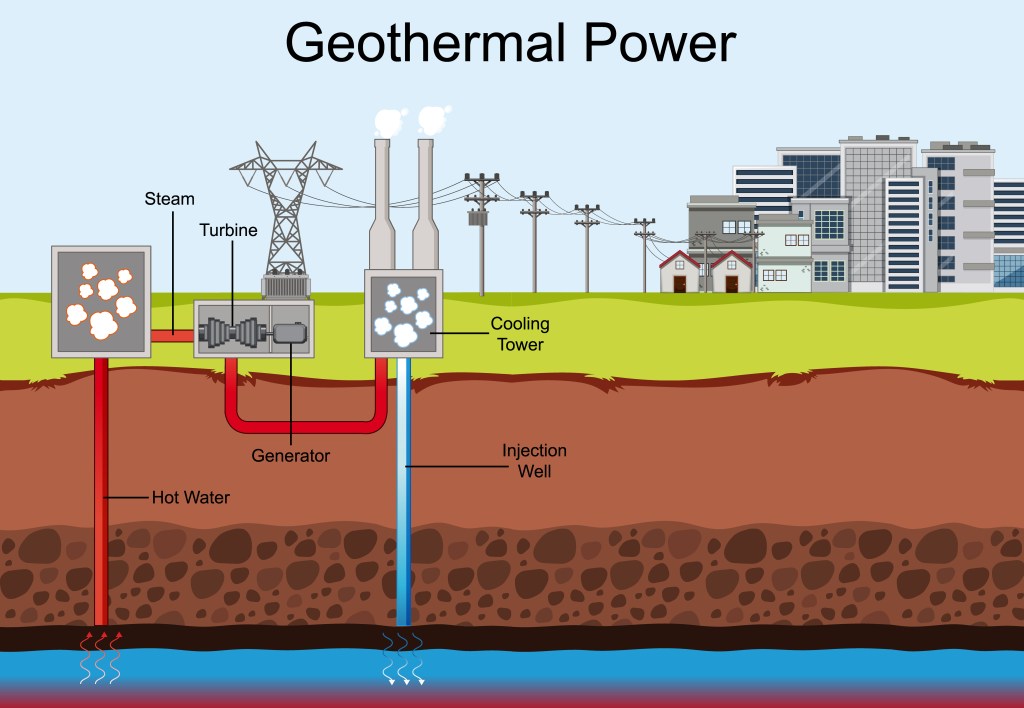
Geothermal Basics

I really enjoyed writing about the basics of how wind turbines work in my last post so we’re going to stick with the basics today as well. So far, this blog has focused on wind turbines because they have been in the news and exciting new developments have occurred in the wind energy sector. Today we’re going to pivot and discuss geothermal energy: what it is and how it works.

Let us first define what geothermal energy is. The thing is everyone already knows of examples of geothermal energy, possibly without knowing it. Geothermal energy is simply heated underground water whose energy can be utilized to generate electricity. The common examples that you are likely aware of are hot springs and geysers. Geothermal vents, where hot water moves from underground reservoirs to the surface and are located along the borders of tectonic plates so the areas in which geothermal energy is a viable source of energy are limited. However, this does not mean that they cannot be a powerful component to the energy grid. In 2018 geothermal energy plants produced 13.3 GW of energy worldwide. That is 13.3 BILLION Watts of clean energy that was already being produced.

Now, how is geothermal energy harnessed? Well, a lot of the same technology that is used to generate electricity from coal is also used to generate geothermal energy. In a coal plant, coal is burned to heat water that then turns into steam. As the steam escapes it turns turbines that that then turn a drive shaft which turns gears on a generator. That sounds familiar, doesn’t it? Essentially, coal and geothermal energy operate like large kettles. The only difference is that coal plants require the combustion of coal while geothermal energy gets its energy from the rives of magma that exist deep within the earth and heat underground water reservoirs.

There are three major types of geothermal energy produce plants. The first is a Dry Steam system, that simply uses the steam that is naturally created to spin a turbine. The second type is a Flash Steam which is a little bit more complicated. First, we must acknowledge that heated water underground is under much greater pressure than atmospheric pressure above ground. This means that this water can get much hotter and remain as a liquid. For this method, the water usually exceeds 350 degrees Fahrenheit. When this water enters a tank on the surface it flashes into steam and again, spins a turbine. The steam is then collected, condensed, and finally reinjected into the underground reservoir.  The final and most complicated geothermal plant is called a Binary Cycle plant. In this system the heated ground water travels through a metal tube that brings it up to the surface. This tube radiates heat and is adjacent to a second tube with a second liquid in it, called a working fluid which has a lower boiling point. The water continues to travel through tube in a loop shape and is returned underground while the second liquid is heated to its boiling point, turned to steam, and used to spin turbines. This second liquid is condensed and collected and returned to its tube to go through the process again.

Picture of a Flash Steam Plant by Brgfx on Freepic

If you liked this post and would like to see a specific form of renewable energy discussed here please leave a comment below sharing your thoughts. And if you would like more information about geothermal energy please follow the links below as they are full of additional information:

What is Geothermal Energry

Geothermal Energy 101

How Wind Turbines Work

In my first post, found here: Most Powerful Turbine I discussed a the most powerful wind turbine coming into production with a capacity to produce 80 gigawatts of energy in a year. Now I usually present what I find exciting in the renewable sphere in a TLDR: “too long didn’t read” format, giving you the highlights of new innovations and arming you with enough information to be the well-informed dinner guest. Today I am going to take a step back and provide you an ELI5: “explain it like I’m five” run down of how wind turbines work.

When you read, “wind turbine” what is it you think of? A big fan-looking contraption with three blades huddled within a gaggle of other like structures. To formalize our definition of wind turbines, these are horizontal axis wind turbines which must face the wind or be “upwind” in order to generate power. The next question is, how do we know what direction the wind will be blowing in to install the turbines? We don’t, and the wind turbines can actually rotate towards the direction of the wind in order to capture it from any direction.

The structure of the blades on a wind turbine are curved and resemble those on plane. By utilizing the curved shape, as wind blows past the blade, an area of decreased air pressure forms and then the higher-pressure air will start rotating the blade. The blades are attached to a drive shaft in the center of the turbine, and as the shaft spins, it will rotate gears in a gear box. These gears will, in turn, rotate a secondary section of a drive shaft more quickly. This secondary section is then connected to a generator. Think of this like when you ride a bike, and you have multiple gears and on the lowest gears you’ll be pedaling away while the wheels only slightly rotate. Except this process is in reverse and the wheels spinning slowly are the turbine blades and the quick rotating pedal is the shaft connected to the generator.

Photo Credit by Brgfx on Freepic

Finally, the electric current runs down a wire to a transformer that will convert the electricity produced by the turbine into a more suitable voltage that can then be distributed to homes or feed into the power grid. If you would like to learn more about wind turbines work, please check the links below for additional information. And I would like to leave you with two turbine related facts. One, the main body of the turbine that houses the gear box and generator is called the nacelle. Two, wind that blows at twice the speed has the potential to produce eight times the amount of energy on a given turbine because the energy in wind has a cubed proportion to its speed!

Explain that Stuff – Wind Turbines

Futuren Group

If you liked this post or would like me to cover any other topics, please leave a comment below.

A Net Carbon Negative Future

Before we get into today’s topic, we need to familiarize ourselves with the Berkeley Laboratory and its role in our energy grid. The Berkeley Lab is a just one facility in a system of energy laboratories in a system of United States Department of Energy National Laboratories and Technology Centers all managed by the department of energy. Recently, the Berkeley Lab released a report about the feasibility of a carbon neutral by 2050 and even carbon negative going farther into the future.

For their most recent report the Berkeley Lab partnered with the consulting firm Evolved Energy Research to tackle the affordability of a reaching Intergovernmental Panel on Climate Change’s recommended goal of net zero carbon emissions by 2050 to limit the effects of climate change. The partnership concluded that the price tag for a carbon neutral United States would be one dollar, per person per day. What this would afford us would be a complete overhaul of our energy infrastructure. Berkeley Lab senior scientist Margaret Torn highlights the journey to a net zero energy grid as needing “to build many gigawatts of wind and solar power plants, new transmission lines, a fleet of electric cars and light trucks, millions of heat pumps to replace conventional furnaces and water heaters, and more energy-efficient buildings – while continuing to research and innovate new technologies.”

Now this may sound like an overwhelming task that will see coal plant shutting down and people going without power as construction crews scramble to install solar panels in time, but luckily this is not the case and in fact, far from it. The Berkeley plan would require no “early retirement” of the infrastructure that we currently have in place, and instead on replacing aging infrastructure with green alternatives as the economic life of old plants and generators comes to an end. This way we only need to bridge the gap as new energy needs arise.

All this has been for the carbon neutral case, but at the beginning of this post I teased something even better, a carbon negative future. The carbon neutral pathway from above would cost roughly 0.4% of US GDP per year to achieve. By investing a little bit more, 0.6% of GDP to be exact, we would be able to sufficiently invest in restructuring our agriculture and forest management, increasing carbon capture, and generating greater amounts of electricity through renewable means. Though, this would also mean greater costs in terms of land use required.

If you’ve enjoyed these last few blogs, please feel free to connect with me on LinkedIn (Arkadiusz Bolanowski) or follow me on twitter (@RKDSBolanowski). Also, if you think this story is interesting and you’d like to learn more, please visit the Berkely lab’s website at https://www.lbl.gov/ .

The Texas Blame Game

Trying to be as a political as I can be given today’s topic, I feel like I need to add my voice and look at possible solutions to situation in Texas. Leaders in Texas from Governor Greg Abbott to Rick Perry were quick to blame the power outages in Texas on the freezing of wind turbines. Governor Abbott himself was quoted saying that wind and solar made up “more than 10%” of the power grid in Texas, and according to the Electric Reliability Council of Texas wind energy made up 15.9% of energy production in Texas in 2018. So how can a 10-15% drop in production cause statewide power outages? The true reason for the outages was not that the turbines froze, which they did, and no one is denying that, but it is because the energy grid all over Texas failed because deregulation of the energy grid in the 1999 has led to less strict standards of upkeep and preparedness.

Now that the elephant in the room has been addressed, lets look at ways that an emergency of this scale can be avoided and let us look at the renewable tools that can make it happen. Since wind turbines are in the forefront of the blame here, we will look at examples of various technologies and methods that turbines have modified to function in artic weather. Swedish researchers have been testing artic wind turbines for years now, with some testing having started as long as a decade ago. At Uljabuoda, Swedish Utility company Skelleftea Kraft AB was one of the first to experiment with wind turbines in the Arctic. The researchers created two solutions to the freezing blade problem. The first is to add a carbon fiber coating on the blades which can be heated to melt the ice. The second method is a system which would not heat the surface of the blades but heat them from the inside instead. Obviously, these upgrades to the wind turbines are costly, a 5% increase in price on average.

Now these methods have shown that wind turbines can be successfully operated within the arctic circle as temperatures as low as -22 degrees Fahrenheit. According to local ABC 13 news, the lowest temperature recorded in Houston during this winter storm was 13 degrees Fahrenheit. And now finally we have to look at the choice that Texas has to make. Is it time to regulate their energy grid more stringently? Would investing into winterproof wind turbines make sense? Was this storm a once in a century storm and do we not need to worry about artic temperatures in Texas any time soon? Or, is this going to become the new normal with climate change and will the investment now pay off in the future? At this time I am earnestly urging you to stay informed about all the facts when renewables get blamed and think about how there are still ways to move forward and not backwards on an unsustainable path.  

Most Powerful Turbine

This week is perfectly timed to start blogging about renewable energy innovations. Danish manufacturer of wind turbines, Vestas, just unveiled their newest and most powerful wind turbine. Now this turbine is not only the most powerful in Vestas’ production, but it is also the strongest wind turbine in the world. The new model is named the V236-15.0 MW and is specifically designed for installation in storm prone areas. I should clarify, that by storm I mean hurricane/typhoon strength storms. I think its clear to see why this is such an outstanding achievement. To be able to harness the power of something so destructive as a hurricane and utilize it for our collective benefit. This behemoth of a wind turbine posses three blades which are 115.5 meters long; for perspective an American football field of 100 yards is 91.44 meters long. While spinning the three blades cover an area equivalent to 10.6 acres.

Now, lets talk about the output of the world’s most powerful wind turbine. From Vestas’ own calculations, each turbine will be capable of producing 80 gigawatt hours of energy in a year. That amount is sufficient to power 20,000 homes. Also, the effects of not producing carbon emissions to create this energy is by itself a marvel. Each wind turbine has the capacity of removing 38,000 tons of carbon dioxide emissions. To provide some perspective on this. In 2017 Amazon’s entire fleet of delivery vehicles produced 19 million tons of carbon emission. Just 500 of these turbines built around the globe would offset the pollution created by our love of convenient shopping. Not to mention, 500 turbines would be able to power 10 million homes. Again, these numbers appear arbitrary so lets put it in perspective again. The entire state of Nevada totals 751 thousand households. The entire US population is 105 million people. This would mean that 500 turbines would be sufficient to power 1/10th of the US population while also offsetting the emissions from our insatiable need for next day delivery of play doh and reversable angry octopus plushies.

I’m not saying that this single turbine is going to be the solution to our energy problems going into the future, but what I am trying to point out are the possibilities for a greener and renewable future. The scalability is there, and this style of wind turbine could be a large piece of the puzzle moving forward. As we continue our conversation about renewables, we will explore more of the crucial pieces that I hope will one day make up our fully renewable energy grid.